Most people who come to us asking about dental implants in Mauritius are focused on the implant itself: the titanium post, the crown, the final aesthetic result. Almost nobody asks about their gums first. That is a mistake that costs some patients thousands of rupees and months of treatment time, because gum health and dental implants are inseparable. An implant placed into a mouth with active or poorly managed periodontal disease is not a solution, it is a setback waiting to happen. At St Jean Dental Care in Quatre Bornes, the periodontal assessment is not a checkbox before implant planning - it is implant planning.
Table of Contents
- Quick Takeaways
- Why Gum Health Is the Foundation of Implant Success
- Gingivitis vs. Periodontitis: What You Need to Know Before Booking a Consultation
- How Periodontal Disease Causes Implant Failure
- Assessing Implant Candidacy in Mauritius: What a Thorough Evaluation Looks Like
- Treating Gum Disease Before Implants: The Steps That Cannot Be Skipped
- Peri-Implantitis: The Risk That Does Not Disappear After Placement
- Comparison: Periodontal Management Approaches for Implant Candidates
- Frequently Asked Questions
Quick Takeaways
| Key Insight | Explanation |
|---|---|
| Active gum disease disqualifies you from immediate implant placement | Placing an implant in an infected environment dramatically increases the risk of osseointegration failure and peri-implantitis. |
| A history of periodontitis remains a risk factor even after treatment | Research confirms that patients with a treated history of periodontitis show higher rates of implant failure and marginal bone loss compared to periodontally healthy patients. |
| Bleeding gums are a warning signal, not a normal occurrence | Gums that bleed when you brush or floss indicate active inflammation. This must be resolved before any implant procedure begins. |
| Bone loss from gum disease can require grafting before implants | Periodontitis destroys the bone that implants anchor into. Severe cases require bone grafting to restore sufficient volume for stable implant placement. |
| CBCT 3D imaging reveals what standard X-rays miss | Cone beam CT scanning measures bone height, width, and density in three dimensions, making it essential for accurate implant candidacy assessment when periodontal history is involved. |
| Scaling and root planing is often the first step, not a minor detail | Non-surgical deep cleaning stabilises gum and bone before implant surgery. Skipping it because a patient is eager for implants is a clinical shortcut that backfires. |
| Long-term maintenance is what keeps implants healthy for decades | Patients susceptible to periodontitis need a stricter recall schedule after implant placement to catch peri-implant mucositis before it progresses to peri-implantitis. |
Why Gum Health Is the Foundation of Implant Success
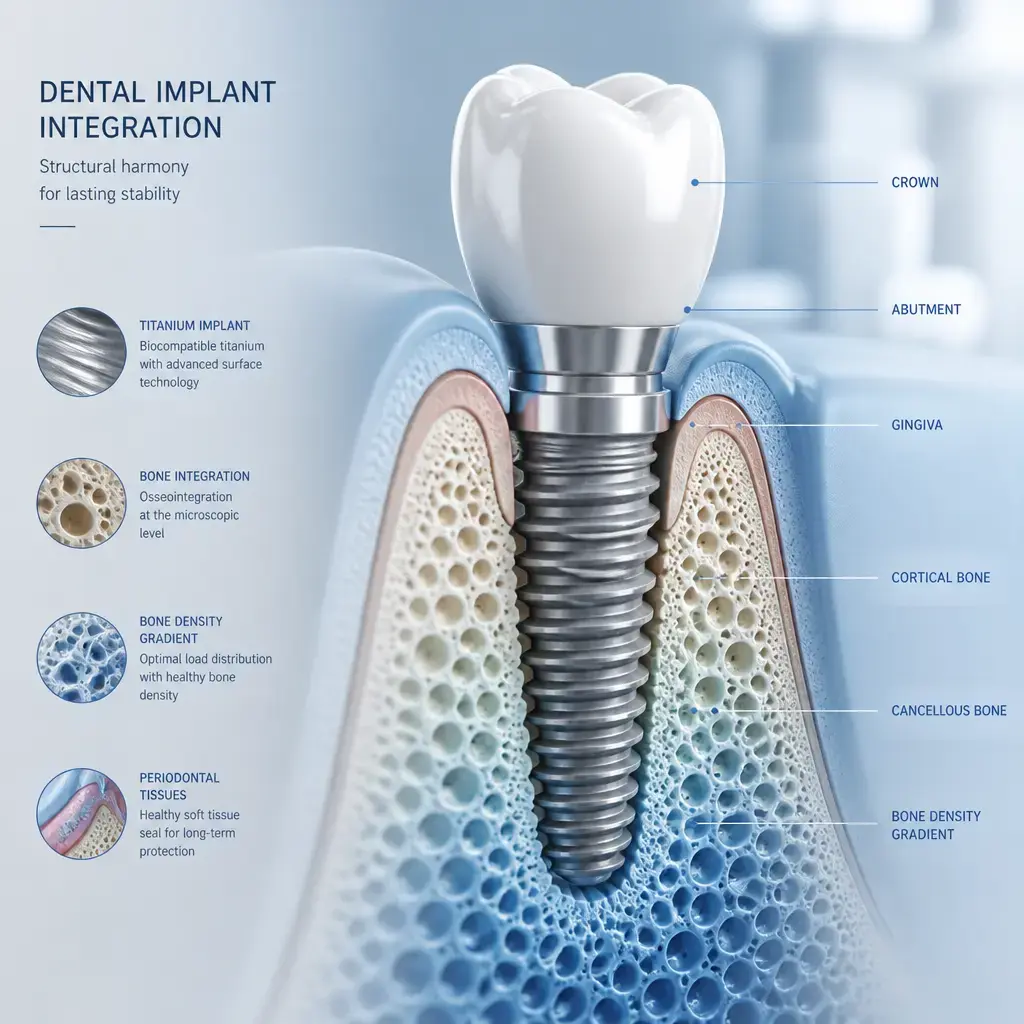
A dental implant is a titanium post that fuses with your jawbone through a biological process called osseointegration. For that fusion to succeed and remain stable over years, it needs two things: adequate bone and healthy soft tissue surrounding it. The gums are not just cosmetic framing around the implant crown. They form a biological seal that protects the underlying bone and the implant surface from oral bacteria.
When that seal is compromised by gum disease, bacteria migrate down the implant surface and trigger inflammation in the peri-implant tissues. This mirrors exactly what happens around natural teeth in periodontitis. The same bacterial pathogens, the same inflammatory pathways, the same bone-destroying mechanism. The implant simply does not have the periodontal ligament that natural teeth use as a partial buffer, which means it can be more susceptible to rapid bone loss once infection takes hold.
This is why, at any reputable clinic offering periodontal health assessment in Quatre Bornes, gum evaluation is not optional. It precedes implant planning, full stop.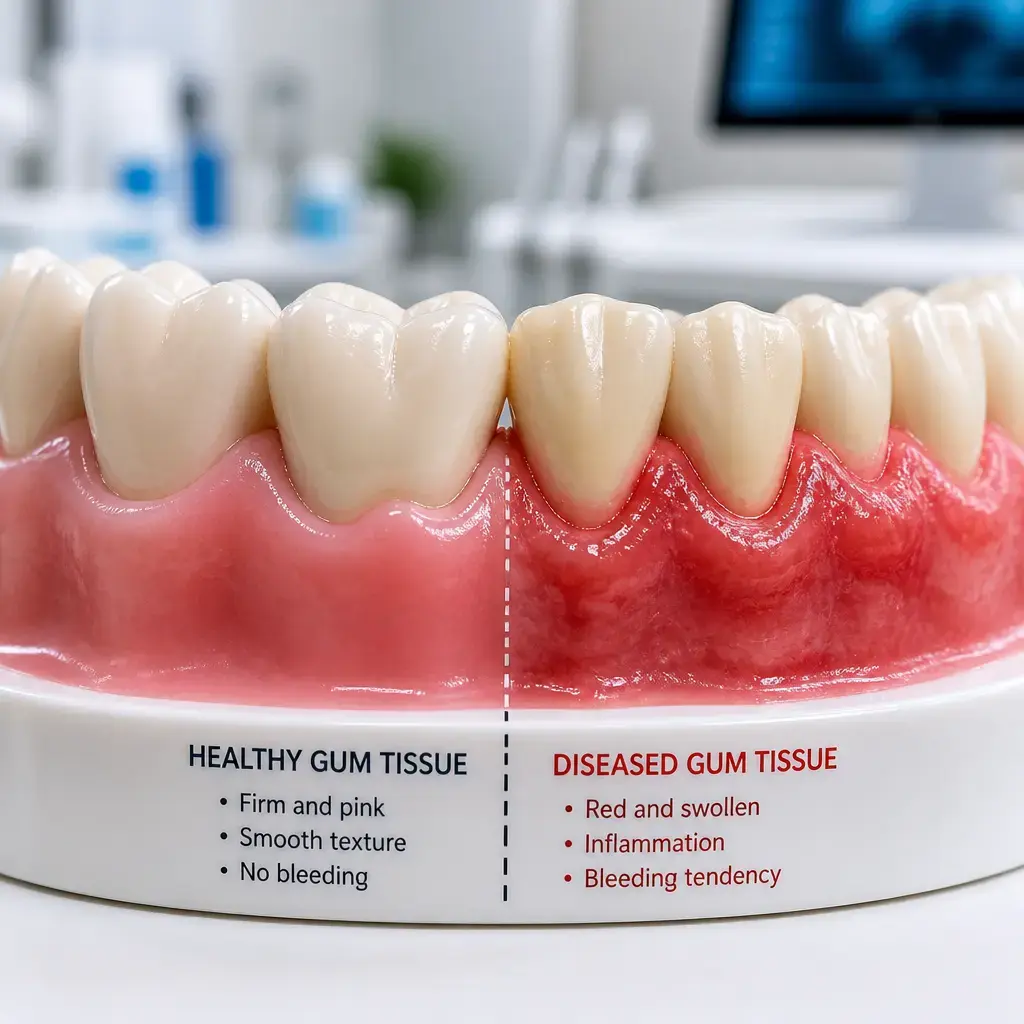
Gingivitis vs. Periodontitis: What You Need to Know Before Booking a Consultation
Many patients confuse the two conditions or assume that because their gums bled "a bit" in the past, they have already dealt with any problem. Gingivitis and periodontitis are not the same disease at different intensities. They are distinct stages with different implications for implant candidacy.
Gingivitis: Reversible Inflammation
Gingivitis is inflammation confined to the gum tissue itself. The bone and connective tissue attaching gum to tooth remain intact. At this stage, damage is fully reversible with professional cleaning and improved home care. A patient with gingivitis can proceed to implant treatment once the inflammation resolves, provided no bone loss has occurred.
Warning signs include red or swollen gums, bleeding when brushing or flossing, and persistent bad breath. Healthy gums are firm, pale pink, and do not bleed with normal brushing.
Periodontitis: Irreversible Bone and Tissue Loss
When gingivitis is left untreated, bacteria advance below the gum line, triggering an immune response that destroys the bone and connective tissue supporting the teeth. This is periodontitis, and the structural damage it causes is permanent. Deep pockets form between gum and tooth, teeth may loosen, and the alveolar bone that implants depend on can be significantly reduced.
A patient with a history of periodontitis is not automatically excluded from implants, but they require more thorough pre-treatment, more careful planning, and a more rigorous maintenance protocol afterward. Research published in peer-reviewed literature confirms that a history of periodontitis is a significant risk factor for implant failure, peri-implantitis, and greater marginal bone loss around implants over time.
Pro tip: If you have been told you have "deep pockets" by any dentist in the past, always disclose this during your implant consultation. It directly affects your treatment timeline and the surgical approach needed.
How Periodontal Disease Causes Implant Failure
The failure mechanism is well understood. The same bacterial species responsible for periodontitis around natural teeth - pathogens such as Porphyromonas gingivalis and Tannerella forsythia - colonise implant surfaces and peri-implant sulcus tissue. In a patient with existing or past periodontal disease, these pathogens are often present in elevated numbers and the host immune response may already be dysregulated.
This creates a compounding problem. The inflammatory response to these bacteria triggers the release of cytokines that break down bone-supporting tissue. Around a natural tooth, some regeneration is possible through the periodontal ligament. Around an implant, there is no such ligament. Once marginal bone loss begins at an implant site, it tends to progress faster and is harder to arrest than equivalent loss around a natural tooth.
Research examining patients with a treated history of chronic periodontitis has found that implants in these patients face higher complication rates over a ten-year follow-up period compared to periodontally healthy controls. The bacterial and immune environment in periodontitis-susceptible patients requires ongoing vigilance.
The same bacterial pathogens and host-susceptibility factors that contribute to periodontitis can also lead to peri-implant diseases. A history of periodontitis is among the most significant patient-specific risk factors for implant complications.
In practice, this means that a patient who had periodontitis five years ago, had treatment, and now has stable, healthy gums is a very different candidate from a patient with active infection. Both need careful evaluation. Neither should be rushed into implant surgery without a proper periodontal status assessment.
Assessing Implant Candidacy in Mauritius: What a Thorough Evaluation Looks Like
Assessing implant candidacy in Mauritius should involve more than looking at a single X-ray and tapping a few teeth. When patients come to St Jean Dental Care asking about implants, the first clinical appointment covers a structured periodontal and radiographic assessment before anything else is discussed.
Periodontal Charting
A full periodontal chart records probing depths at six points around each tooth, bleeding on probing, recession measurements, furcation involvement, and tooth mobility. This gives a precise picture of where disease is active, where bone loss has already occurred, and what the risk level is for implant placement at specific sites.
CBCT 3D Imaging for Bone Volume and Quality
Conventional two-dimensional X-rays cannot show bone width, density variations, or the exact three-dimensional relationship between the proposed implant site and adjacent structures like the sinus floor or the inferior alveolar nerve. CBCT cone beam imaging solves this. By providing multiplanar visualisation of the jaw, CBCT allows precise measurement of crestal bone height and facial alveolar bone thickness - both of which are directly affected by periodontal bone loss.
At St Jean Dental Care, in-house CBCT 3D scan imaging means this assessment happens on site during the evaluation process. The data feeds directly into the implant planning process and identifies whether bone grafting will be needed before or at the time of implant placement.
Medical History and Systemic Risk Factors
Certain systemic conditions interact with both gum disease and implant outcomes. Uncontrolled diabetes, for instance, impairs the immune response and delays healing, amplifying periodontal destruction and increasing peri-implant complication rates. Smoking is a well-documented risk factor for both periodontitis progression and implant failure. A complete medical history provides essential clinical data that helps tailor the treatment plan.
Pro tip: Bring a list of all medications to your implant consultation. Some medications, including certain blood pressure drugs and antidepressants, reduce saliva flow and increase susceptibility to gum disease and peri-implant infection.
Treating Gum Disease Before Implants: The Steps That Cannot Be Skipped
There is no shortcut through this phase. Patients sometimes arrive having already mentally committed to a specific timeline for their implant treatment. The reality is that the timeline is set by the biology, not the calendar. Placing an implant before gum disease is fully controlled does not save time. It risks unnecessary complications and compromises the long-term prognosis of the implant.
Non-Surgical Periodontal Therapy
For most patients, the first phase of treatment is scaling and root planing. This non-surgical deep cleaning removes calculus and bacterial biofilm from below the gum line and smooths root surfaces to discourage further bacterial adhesion. It is not the same as a standard hygiene appointment. It is targeted debridement of infected pockets, commonly performed under local anaesthetic for patient comfort.
After scaling and root planing, the gums are reassessed. If bleeding on probing has reduced, probing depths have decreased, and inflammation is controlled, the patient is in a far better position for implant surgery. The reassessment period typically runs six to eight weeks after the initial treatment.
Surgical Periodontal Treatment When Needed
In cases where non-surgical treatment does not adequately resolve deep pockets or where significant bone defects exist, surgical periodontal treatment may be required. This involves reflecting the gum tissue to access and clean deeper structures directly, and may include regenerative procedures to address bone defects.
Bone Grafting for Sites with Significant Bone Loss
When periodontitis has caused substantial bone loss at the intended implant site, there may not be enough bone volume to support a standard implant without augmentation. Bone grafting rebuilds the alveolar ridge, restoring the volume and density needed for stable osseointegration. The graft material integrates over several months before implant placement proceeds, which adds time to the overall treatment timeline but helps establish a predictable foundation.
Peri-Implantitis: The Risk That Does Not Disappear After Placement
Peri-implantitis is the implant equivalent of periodontitis. It is a bacterial infection affecting the soft tissue and bone around a placed implant, and it can develop at any point after placement, not just early on. The earlier it is detected, the better the chances of arresting it without implant loss.
Patients who have a history of periodontitis are at higher risk of developing peri-implantitis, even years after successful implant placement. This is not a reason to avoid implants. It is a reason to be systematic about maintenance. Evidence from long-term studies shows that among patients with previous periodontitis, peri-implantitis can affect a notable proportion of implants over a decade of follow-up.
The clinical indicators to watch for include bleeding on probing around the implant, increasing probing depths, visible bone loss on radiographs, and in more advanced cases, implant mobility. At the mucositis stage (inflammation without bone loss), the condition is reversible with professional cleaning and improved home hygiene. Once bone loss begins, more targeted intervention is needed.
Maintenance appointments for implant patients with a periodontal history should be more frequent than the standard twice-yearly recommendation. In practice, a three to four month recall interval is often appropriate for higher-risk patients, with radiographic monitoring at regular intervals to catch bone level changes before they become severe.
Comparison: Periodontal Management Approaches for Implant Candidates
Not all approaches to managing periodontal health before and after implant placement are equal. The table below compares the three main clinical scenarios and what each requires.
| Patient Scenario | Pre-Implant Periodontal Requirements | Post-Implant Maintenance Protocol |
|---|---|---|
| No history of gum disease, healthy gums | Standard periodontal charting and hygiene appointment before surgery. No deep treatment needed if gums are healthy. | Standard six-monthly recall appointments with implant-site probing checks. |
| History of gingivitis (no bone loss) | Professional cleaning to eliminate active inflammation. Reassessment before surgery to confirm full resolution. | Three to four monthly recall for the first year, moving to six-monthly if stable. |
| History of periodontitis (with bone loss) | Full scaling and root planing, surgical treatment if needed, CBCT assessment for bone volume, possible bone grafting before or at implant placement. Minimum 6-8 week reassessment period before surgery. | Three to four monthly recall indefinitely. Annual radiographic bone level monitoring. Strict home care compliance required. |
Frequently Asked Questions
Can I get dental implants if I currently have gum disease?
Not immediately. Active gum disease must be fully treated and your gums and bone must be stabilised before implant surgery. Placing implants into an infected environment dramatically increases the risk of failure. Most patients with gum disease can become suitable implant candidates after proper periodontal treatment.
How long do I need to wait after gum disease treatment before getting implants in Mauritius?
There is no universal waiting period because it depends on the severity of disease and your response to treatment. After non-surgical therapy such as scaling and root planing, a reassessment takes place typically six to eight weeks later. If gum health is stable and no further surgical intervention is needed, implant planning can begin. If bone grafting is required, the total preparation period may extend to several months.
Does having had periodontitis in the past mean my implants will fail?
Not necessarily, but it does mean your risk of complications is higher than average, and that you need more careful management. Research consistently shows that patients with a treated history of periodontitis face a higher risk of peri-implantitis and greater marginal bone loss around implants over time. With thorough pre-treatment, precise surgical planning, and a strict maintenance schedule, favourable long-term outcomes remain achievable for most patients.
What is the difference between peri-implant mucositis and peri-implantitis?
Peri-implant mucositis is inflammation limited to the soft tissue around an implant, without any bone loss. It is reversible with professional cleaning and improved oral hygiene. Peri-implantitis involves both soft tissue inflammation and progressive bone loss around the implant. It is more serious, harder to treat, and can ultimately lead to implant failure if not addressed early. Mucositis caught during routine recall appointments can be resolved before deeper tissue damage occurs.
Does the type of implant or crown technology affect gum health outcomes?
Clinical technique and implant surface design are primary factors, but prosthetic components matter too. Poorly fitted crowns can trap plaque at the gum line, increasing inflammation risk. At St Jean Dental Care, in-house same-day crowns technology allows precisely fitting restorations that seat cleanly at the gum margin, reducing the risk of excess cement and plaque accumulation that are associated with peri-implant inflammation.
How does CBCT imaging help with gum and implant assessment specifically?
Standard two-dimensional dental X-rays show bone height but cannot accurately show bone width, density, or the three-dimensional shape of a defect. CBCT provides cross-sectional views in all planes, allowing clinicians to measure how much bone remains after periodontal damage, identify hidden defects, and plan the implant position and angle with precision. This is especially important when bone grafting decisions are being made, as it helps determine the volume of graft material needed and the ideal implant site.
Is periodontal maintenance after implant placement really necessary long-term?
Yes. Implants do not develop cavities, but they are susceptible to bacterial-driven inflammation in the surrounding tissue. For patients with a periodontal history, long-term professional maintenance is what helps protect implant stability over time. Stopping recall appointments because the implant feels comfortable is a common mistake that can lead to unnoticed complications.